
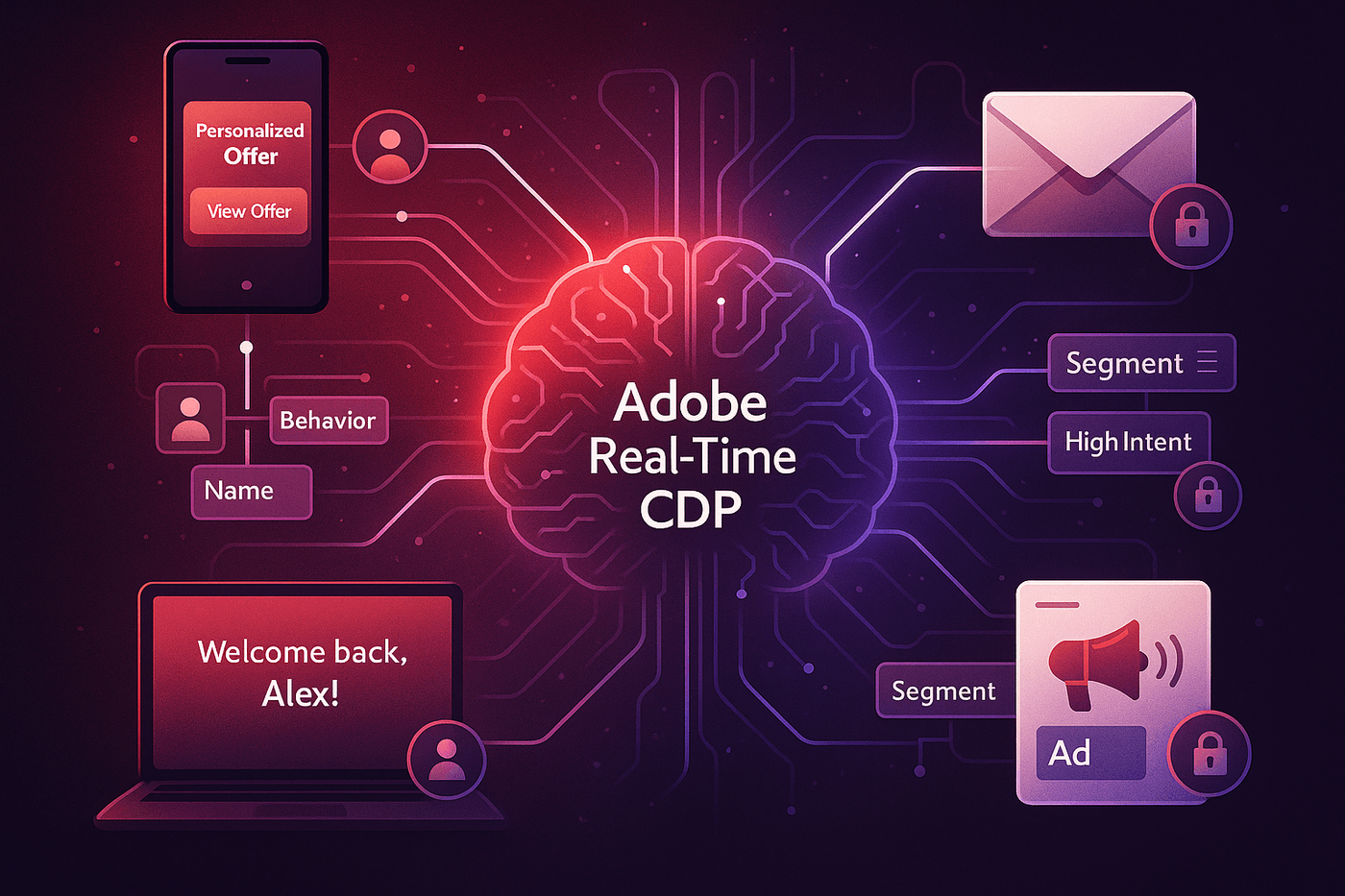
Customer expectations have changed faster than most marketing teams can keep up. Today’s users jump between devices, browse at unpredictable times, and expect brands to remember their preferences instantly. If the experience lags - even by minutes - it feels disconnected.
But the real challenge is often behind the scenes: Data sprawled across systems, insights that arrive too late, and activation workflows that depend on batch jobs from yesterday.
This is where Adobe Real-Time CDP (RT-CDP), built on Adobe Experience Platform (AEP), steps in. It doesn’t just centralize customer data - it makes that data usable the moment it arrives.
Why Real-Time Personalization Has Become Non-Negotiable
Customer journeys rarely follow a straight line anymore. A typical path might look like this:
- browsing a product on a mobile app
- returning via laptop later in the day
- opening an email the next morning
- clicking on a social ad two days later
And through all of this, customers expect brands to keep up.
To do this effectively, teams need:
- a single, unified profile
- real-time updates as behaviors happen
- instant activation across channels
- strong governance to protect customer trust
Adobe RT-CDP gives organizations a framework to deliver this without duct-taping multiple systems together.
What Adobe Real-Time CDP Actually Does
Adobe RT-CDP brings data together from systems that usually speak different “languages.” Instead of stitching everything manually, it provides a consistent foundation using XDM (Experience Data Model). Think of XDM as a universal schema that stops teams from wrestling with incompatible formats.
Here’s how the platform works end to end:
-
Unified Data Collection
RT-CDP ingests data from nearly any source - web analytics, CRM, mobile apps, call centers, point-of-sale systems, and even offline files.
The key difference with AEP is structure.
Once data enters the platform, XDM gives it a shared meaning. A “purchase,” a “profile update,” or a “page view” follows the same definition everywhere.
This alone saves teams hours of cleanup and reduces errors in activation.
-
Real-Time Profiles (Identity Stitching in Action)
RT-CDP’s identity stitching is one of the most powerful parts of the platform. It connects customer identifiers like:
- ECID
- Phone number
- CRM or loyalty IDs
Instead of treating every touchpoint as a separate event, Adobe Identity Service merges them into a single, living profile.
A practical example:
A user browses anonymously on Monday, then logs in on Tuesday. RT-CDP retroactively links that earlier activity to the known customer profile. Suddenly, insights that were once scattered start telling a coherent story.
-
Streaming Segmentation
Traditional segmentation works in batches - useful, but too slow for modern journeys.
Streaming segmentation, on the other hand, reacts the moment behavior changes.
If a visitor reads two pricing pages in under ten minutes, RT-CDP doesn’t wait for a nightly job to classify them as a high-intent prospect - it does it immediately.
This helps teams deliver:
- faster onsite personalization
- real-time email/push triggers
- quicker retargeting
- dynamic journey entry conditions
It’s personalization at the pace the customer expects.
-
Cross-Channel Activation (Instant Delivery Where It Matters)
Once a customer qualifies for a segment, Adobe RT-CDP can activate them across:
- Adobe Target (personalized web/app experiences)
- Journey Optimizer (email, push, SMS)
- Advertising destinations like Meta, Google, DV360
- CRM and data warehouses
One common feedback we hear from teams:
“We no longer wait for IT or batch jobs - activation is ready within minutes.”
This consistency across channels is where real business impact shows up.
A Simple Real-Time Example
Imagine this sequence:
- A customer lands on a product page and shows clear interest.
- The event is captured in XDM format and streamed into AEP.
- Their unified profile updates instantly.
- A streaming segment flags them as high-intent.
- Within seconds, they receive:
- an onsite recommendation
- an email nudge
- or a mobile push
All triggered automatically - before the customer even leaves the page.
That is what “real time” actually feels like.
Making Segmentation Work at Scale
Adobe RT-CDP supports three styles of segmentation, each tailored to different needs:
Batch Segmentation
Great for planned campaigns, large audiences, and predictable schedules.
Streaming Segmentation
Reacts to behaviors as they occur - ideal for high-intent actions
Edge Segmentation
Used when milliseconds matter, such as mobile apps or IoT devices.
A simple analogy:
- Batch = a daily report
- Streaming = a live scoreboard
- Edge = instant scoring on the field
Data Governance: From Labels to Enforcement
Governance isn’t just a checkbox for compliance - it protects customer trust and prevents accidental misuse of sensitive data.
Adobe’s framework (labels → policies → enforcement) ensures teams activate data responsibly:
Labels
Think of them as markers on your data.
You can classify fields with Contract (C), Identity (I), or Sensitive (S) labels - plus any custom labels your organization needs.
Policies
Policies define what’s allowed and what’s not.
For example:
- “Data with Sensitive (S) labels can’t be used for advertising.”
- “Marketing can use email if consent is present.”
Enforcement
When activating audiences, AEP checks:
- the labels
- the policies
- the destination’s risk level
If something breaks the rules, activation is blocked - with a clear explanation of which field triggered it.
This helps avoid accidental compliance issues long before they become problems.
Privacy Service: Handling GDPR/CCPA Requests Properly
Adobe’s Privacy Service focuses on data subject rights - access and delete requests.
A few things teams should know:
- You must supply valid identifiers (ECID, email, phone, CRM ID)
- Only real customer requests should be processed
- Load testing is not allowed
- The service runs in production, not sandbox environments
Once a request is submitted, AEP orchestrates the deletion or retrieval across Adobe Experience Cloud applications and sends updates through UI, API, or webhooks.
This gives organizations a predictable, audit-ready workflow.
Monitoring & Optimization: Staying Ahead of Issues
AEP offers a suite of monitoring capabilities that help teams keep pipelines healthy:
- Dataflows UI to inspect ingestion and activation
- Observability Insights to track latency, throughput, and errors
- Alerts for anomalies
- Dashboards for identity stitching, data quality, and dataset health
Teams often discover configuration issues early through these dashboards - before they impact personalization.
My Key Takeaways from RT-CDP Training
Working through the Adobe Real-Time CDP Business Practitioner curriculum changed how I look at personalization. It’s not about pushing more messages - it’s about recognizing intent and responding in the moment, in a way that respects consent and context.
The combination of unified profiles, real-time segmentation, and governed activation genuinely bridges the gap between what customers expect and what most brands currently deliver.
Final Thoughts
Adobe Real-Time CDP is more than a data platform - it’s the engine that powers meaningful personalization across the Adobe Experience Cloud. When implemented well, it helps brands deliver experiences that feel relevant, timely, and trustworthy.
If you're exploring RT-CDP or looking to elevate your personalization maturity, feel free to reach out. Get in touch — we’d be happy to share learnings, help assess your setup, or guide your implementation.
Let’s build real-time experiences that actually move the needle.