Introduction
Adobe AEM Edge Delivery Services (EDS) has ended the performance debate with lightning‑fast delivery and simplified architecture. The real question now is authoring: which model best balances governance, velocity, and long‑term maintainability in AEM Edge Delivery Services?
Business leaders are asking:
- How do we empower authors to move faster without losing governance?
- How do we avoid long‑term complexity while scaling content operations?
- How does this choice impact external discoverability in search engines and AI platforms?
Who Are the Authors?
In the context of AEM Edge Delivery Services, authors are the people inside the enterprise responsible for creating and managing digital experiences:
- Marketing Authors → launch campaigns, promotions, and microsites quickly.
- Content Authors → update product descriptions, localized content, and day‑to‑day site changes.
- Business Authors → enforce compliance, governance, and structured workflows.
- Hybrid Technical Authors → developers who occasionally act as authors when bridging content and code.
Empowering these authors means giving them speed and flexibility, while governance ensures compliance, scalability, and discoverability.
Why Performance Is No Longer the Debate
Adobe AEM Edge Delivery Services delivers modern, composable architecture and unmatched Lighthouse scores. The challenge now is authoring: how marketing and IT teams collaborate to deliver content at scale.
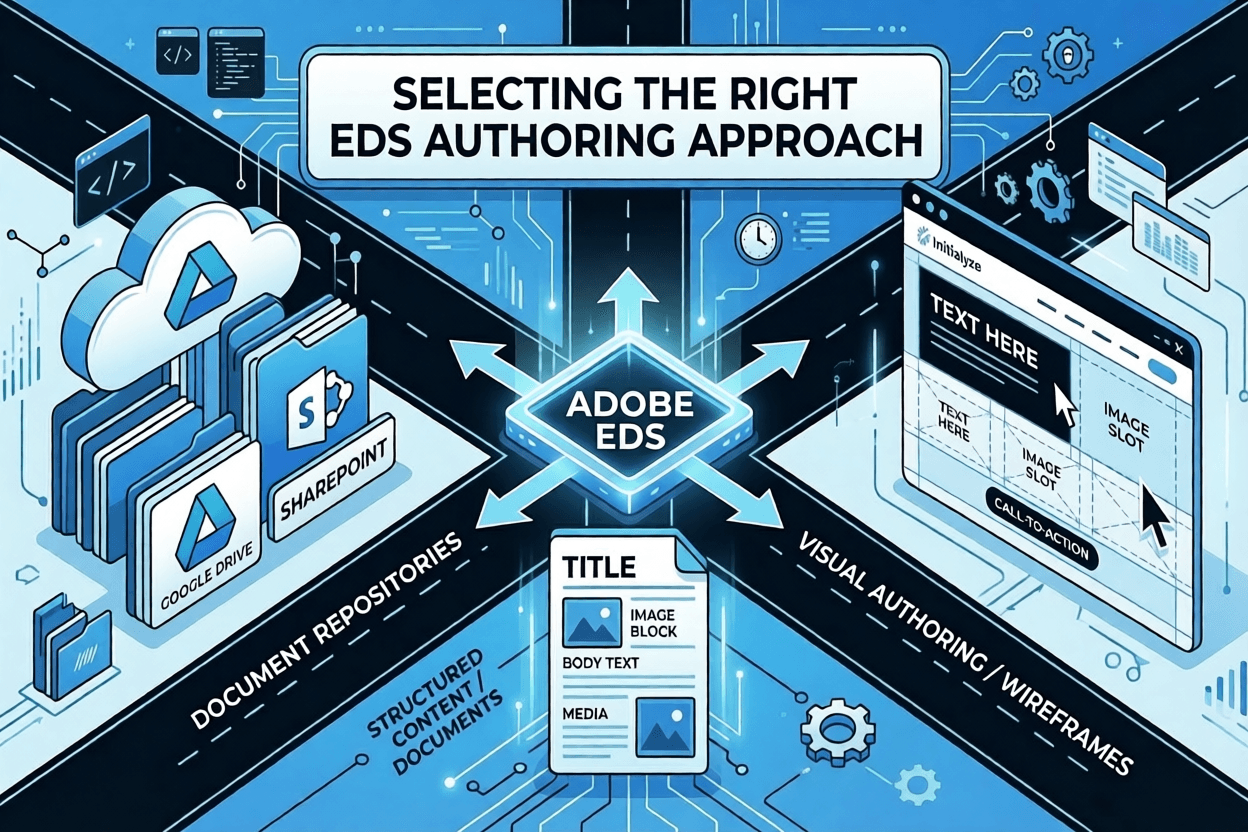
The Three Authoring Paths in AEM EDS
-
Pure Document Authoring (Google Drive / SharePoint)
- Speed and Simplicity: Content teams can create and publish quickly using familiar document tools without complex CMS workflows.
- Governance Consideration: Limited governance controls can make large scale enterprise management challenging.
- Discoverability Impact: Enables rapid campaign launches, but inconsistent content structures can weaken search visibility and long term SEO performance.
-
DA.Live (Document Authoring + Asset Integration)
- Hybrid Flexibility: Combines document based authoring with asset management capabilities for more structured content delivery.
- Operational Complexity: Provides more control than pure document authoring but introduces additional workflow considerations.
- Discoverability Impact: Balanced structure for search engines and AI discovery, though teams must maintain consistent practices to avoid technical debt.
-
Universal Editor with AEM Sites
- Enterprise Governance: Advanced content management capabilities with workflows and structured content models.
- Scalability and Localization: Supports MSM, localization, and structured authoring for global digital experiences.
- Discoverability Impact: Strongest model for structured content, compliance, and AI reuse, though onboarding may require organizational maturity.
The Authoring Trade‑Offs
Every enterprise faces the same balancing act:
- Governance vs. Velocity: Can you move fast without losing control?
- Flexibility vs. Maintainability: Will today’s shortcuts create tomorrow’s technical debt?
- Innovation vs. Operational Reality: Are teams ready for new workflows without disruption?
These are not just technical trade‑offs — they are business trade‑offs that shape scalability, compliance, and customer experience.
Helping Teams Navigate the Shift
To make this decision easier, Initialyze built the Adobe AEM Edge Delivery Content Source Assessment. It provides:
- Tailored recommendation based on organizational maturity
- Confidence score for decision support
- Side‑by‑side comparison of Document‑Based, DA.Live, and Universal Editor
- Clear rationale behind each recommendation
Assess your authoring maturity today with this tool
Why Discoverability Matters
- Performance: Lightning‑fast delivery ensures sites load instantly, improving user experience and reducing bounce rates. This speed also strengthens SEO rankings, making content more competitive in search results.
- Velocity: Marketing and content teams can launch new sites or campaigns in days instead of weeks. Faster time‑to‑market gives enterprises greater agility to respond to customer needs.
- Governance: Enterprise workflows maintain compliance, scalability, and brand consistency. This allows organizations to move quickly without sacrificing structure or security.
- Discoverability: Structured content surfaces higher in search engines and AI platforms. This visibility ensures enterprises are not only present but also trusted as authoritative sources.
- Revenue Outcomes: Better visibility drives more qualified traffic and higher engagement. Ultimately, discoverability translates into stronger conversions and pipeline growth.
Looking Ahead
This is the conversation the Adobe AEM community needs right now. As more organizations adopt Edge Delivery Services, the authoring model decision will define success — not just in terms of performance, but in governance, scalability, discoverability, and conversions.