
Adobe Edge Delivery Services (EDS) gives marketing and publishing teams the freedom to choose how they author content—without being locked into a single system.
With EDS, teams can author content using:
- Google Drive or SharePoint
- AEM with Universal Editor
- Document Authoring (a Google Docs / SharePoint–like authoring experience)
But what happens when you haven’t finalized a single authoring approach—or when different site sections need different tools?
That’s where Repoless becomes a game changer.
Why Repoless Matters
The Repoless feature in EDS allows you to:
- Use multiple content sources
- Share one common codebase
- Launch multiple sites with the same look & feel, while keeping content fully independent
In short:
Design and behavior stay consistent. Content stays flexible.
This is especially powerful for:
- Global or multi-brand websites
- Regional rollouts
- Microsites, campaigns, or resource hubs
- Teams experimenting with different authoring tools
What Is Repoless—and How Does It Work?
Traditional EDS (Helix 4)
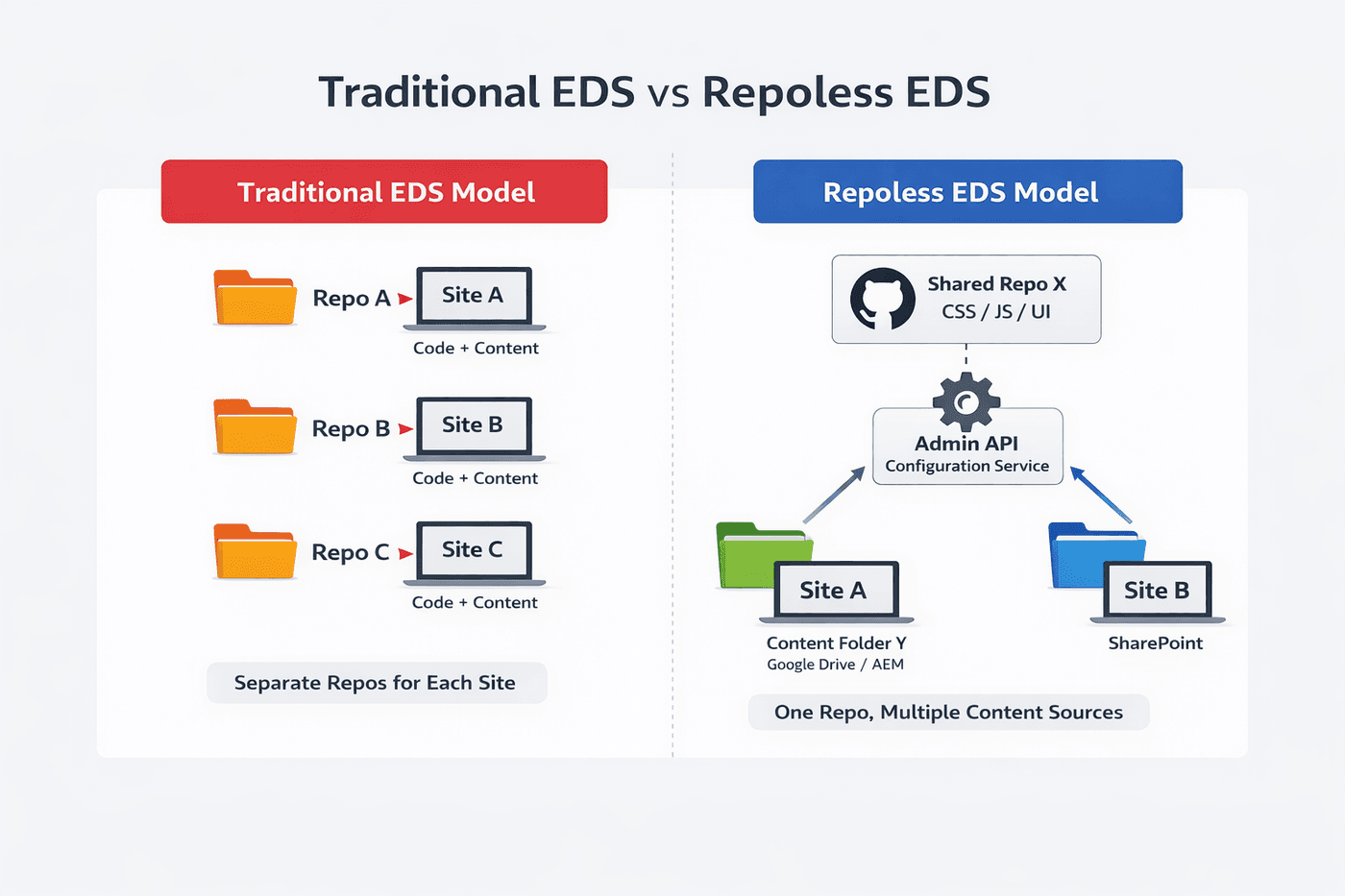
In a traditional setup, each site is tightly coupled to a single GitHub repository.
- One repo = one site
- Code and content are closely bound
- Scaling to multiple sites often means duplicating repos
This can quickly lead to repository drift and governance challenges.
Repoless EDS (Helix 5)
Repoless introduces a decoupled architecture powered by the Admin API Configuration Service.
Instead of a 1:1 relationship between site and repo, the configuration service tells EDS:“For Site A, use code from Repo X and content from Folder Y.”
“For Site B, use the same code from Repo X, but content from Folder Z.”
The result:
- One shared CSS/JS codebase
- Multiple content sources
- Instant updates across all sites
- Centralized governance and control
Traditional EDS vs Repoless EDS: What Really Changes?
In traditional EDS, most configuration lived either:
- In the code repository, or
- At the content source level
With Repoless, all of this moves into a central Configuration Service, adding:
- A governance layer
- Role-based access control
- Cleaner separation of responsibilities
| Configurations | Traditional EDS | Repoless EDS |
|---|---|---|
| Content Source | fstab.yaml |
ContentConfig |
| Folder Mappings | fstab.yaml |
FoldersConfig |
| robots.txt | robots.txt in Github |
RobotsConfig |
| CDN | .helix/config.xlsx | CDNConfig |
| Headers | .helix/headers.xlsx | HeadersConfig |
| Additional Metadata | .helix/config.xlsx | MetadataConfig |
| Access | .helix/config.xlsx | AccessConfig |
| Sidekick Plugins | tools/sidekick/config.json |
SidekickConfig |
| Index Definitions | helix-query.yaml in GitHub |
IndexConfig |
| Sitemap Definition | helix-sitemap.yaml in GitHub |
SitemapConfig |
What Repoless Unlocks for Teams
- Faster site launches without duplicating repos
- Consistent branding across regions and brands
- Simplified maintenance—update once, ship everywhere
- Better governance with centralized configuration
- Freedom to mix authoring tools as your needs evolve
Need Expert Help?
If you’re exploring AEM or Edge Delivery Services and want to unlock the full potential of Repoless, Initialyze can help you design, implement, and scale high-impact digital experiences.
- Read more insights: initialyze.com/insights
- Start a conversation: initialyze.com/contact
Let’s build something impactful—together.